
Are Firefighter Gloves Actually Fireproof?
The U.S. Fire Administration estimates that more than 23,000 firefighters are injured on the fireground each year, with approximately 87% of those injuries occurring during structure fires. That matters because structural firefighting is exactly where crews face the combined hazards of heat, flame, sharp debris, hazardous fluids, chemicals, tools, hose lines, ladders, and mechanical stress.
So, are firefighter gloves actually fireproof? No glove should be treated like unlimited protection against heat, flame, sharp debris, fluids, chemicals, or mechanical hazards. The better question is whether the glove is built, certified, properly fitted, and maintained for the exact job your crew is doing.
Firefighter gloves sit at the point where protection and hand function meet. Your crew needs thermal protection, grip, dexterity, moisture control, cut resistance, and a clean interface with turnout sleeves, tools, hose, ladders, radios, and rescue equipment.
Key Takeaways
- Firefighter gloves are not “fireproof” in an unlimited sense. Structural gloves are built around defined thermal, moisture, and barrier protection, but buyers still need to verify standards, certification language, TPP data, materials, fit, and use case.
- Structural, extrication, rescue, wildland, EMS, and hazmat gloves solve different problems. One glove should not be assumed to fit every fire service task.
- Hunter Apparatus approaches glove selection as a verification process. We look at the call type, hazard profile, certification needs, fit, dexterity, care requirements, and product documentation before recommending a glove direction.
Understanding Firefighter Glove Protection
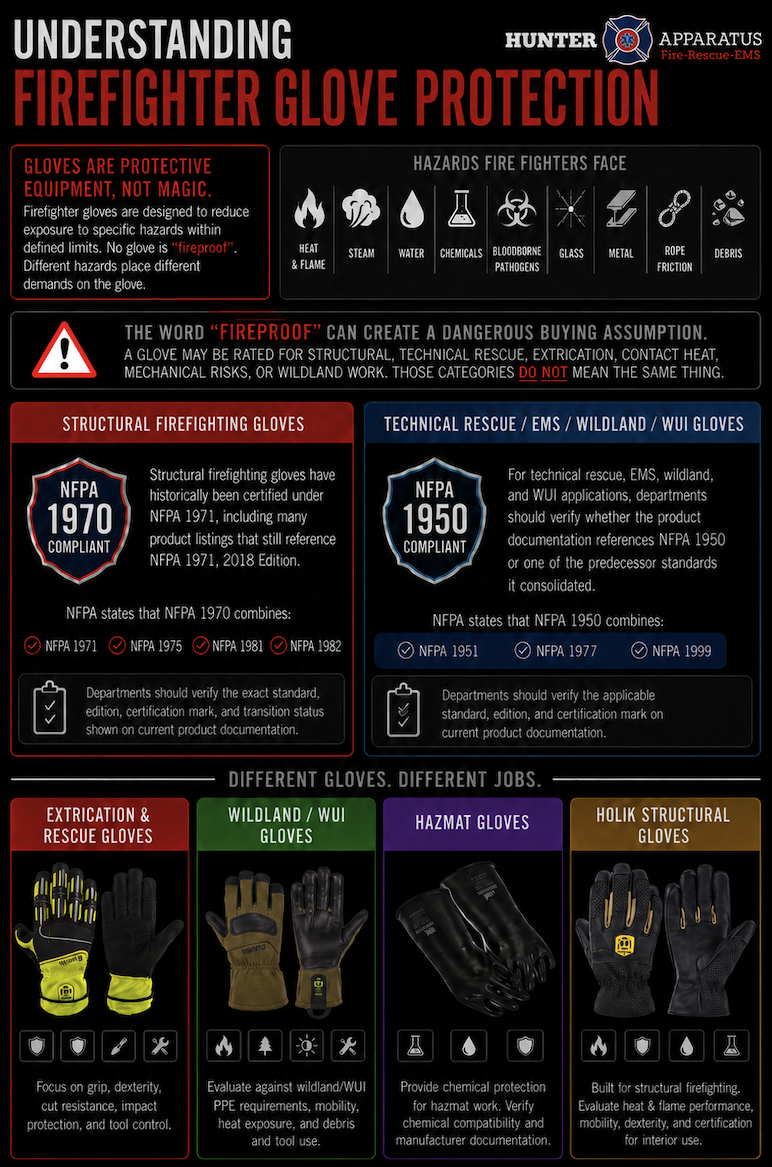
Firefighter gloves are protective equipment, not magic. They are designed to reduce exposure to specific hazards within defined limits. Heat, flame, steam, water, chemicals, bloodborne pathogens, glass, metal, rope friction, and debris all place different demands on the glove.
That matters because the word “fireproof” can create a dangerous buying assumption. A glove may be rated for structural firefighting, technical rescue, extrication, contact heat, mechanical risks, or wildland work. Those categories do not mean the same thing.
Structural firefighting gloves have historically been certified under NFPA 1971, including many product listings that still reference NFPA 1971, 2018 Edition. NFPA has now consolidated NFPA 1971 into NFPA 1970, so departments should verify the exact standard, edition, certification mark, and transition status shown on current product documentation. NFPA states that NFPA 1970 combines NFPA 1971, NFPA 1975, NFPA 1981, and NFPA 1982.
For technical rescue, EMS, wildland, and WUI applications, departments should verify whether the product documentation references NFPA 1950 or one of the predecessor standards it consolidated, including NFPA 1951, NFPA 1977, or NFPA 1999. NFPA states that NFPA 1950 combines NFPA 1951, NFPA 1977, and NFPA 1999.
Non-structural gloves serve a different purpose. Extrication and rescue gloves often focus more on grip, dexterity, puncture protection, abrasion resistance, cut resistance, impact protection, and tool control. Wildland gloves should be evaluated against the applicable wildland/WUI PPE requirements, mobility needs, flame and heat exposure, debris, tool use, and heat-stress concerns. Hazmat gloves are a separate selection problem. Departments should not assume that a structural, extrication, or rescue glove provides the chemical compatibility needed for hazmat work unless the manufacturer documentation specifically supports that exposure.
The decision is not “which glove is fireproof.” The decision is which glove has the right protection package for the call, the task, and the department spec.
Why Firefighter Glove Protection Matters for Firefighters
Hands are working tools on every call. Firefighters use them to run hose, climb ladders, operate nozzles, move debris, use radios, hold tools, adjust gear, open compartments, handle patients, and perform fine detail work. Gloves have to protect the hand while still letting the firefighter work.
That is where many departments run into trouble. More protection often adds bulk. Bulk can reduce dexterity, grip, breathability, and fine control. Less bulk can improve movement, but may not provide enough protection for a structural fireground or another high-risk environment.
Personnel safety is the first concern. Glove choice affects exposure to burns, abrasions, cuts, punctures, moisture, chemicals, pathogens, and heat stress. If gloves do not match the hazard, your crew may be under-protected. If gloves are too stiff or too hard to use, firefighters may remove them during work, which creates another exposure risk.
Mission readiness is also part of the decision. A glove that works well during a demo may not work under wet, dirty, hot, fatigued, or rushed conditions. Donning with sweaty hands, doffing when tired, gripping wet tools, handling small objects, and keeping the lining in place all matter during real calls.
Procurement risk comes from weak specification review. If a committee only asks for “firefighter gloves,” the purchase can miss the actual need. A structural glove, extrication glove, wildland glove, EMS glove, and hazmat glove are not interchangeable. Standards, materials, cuff style, lining behavior, care instructions, certification language, and fit system need review before purchase.
Liability and compliance concerns also matter. If a department buys gloves for a task without confirming the relevant standard, certification, or documented limitation, the issue becomes more than comfort. It becomes a safety and procurement record problem.

Common Challenges, Risks, or Buyer Mistakes
Mistake 1: Treating “Fireproof” as a Real Specification
“Fireproof” is not enough for procurement. The term does not tell you the glove standard, test method, TPP data, heat exposure limit, moisture barrier, cut rating, puncture rating, chemical compatibility, cuff design, or cleaning requirements.
A structural glove may be built for high heat and flame exposure under NFPA structural firefighting requirements. An extrication glove may be built around EN 388 mechanical-risk protection. A hazmat glove may use materials selected for chemical resistance. Those are different protection profiles.
The safer procurement question is: what documented hazards is this glove built and certified to address?
Mistake 2: Buying One Glove for Every Call
Many firefighters find value in having both a structural glove and a non-structural glove because the protection profiles are different.
Structural gloves are heavier duty and built for tough jobs. That extra protection can make them thicker, less breathable, and less flexible. Non-structural gloves can often be lighter and more flexible because they do not have to meet the same thermal protection requirements.
That does not make one category better. It means each category belongs in the right place.
Mistake 3: Ignoring Dexterity
Dexterity is not a comfort extra. It affects safety and task completion. Firefighters need to grip tools, manipulate equipment, use radios, pick up small items, move debris, and maintain control under load.
A practical field test can be useful during evaluation. Try picking up small objects, operating radio controls, handling a tool, and performing common task motions while wearing the glove. That type of test does not replace certification review, but it makes the point clearly. A glove that blocks fine motor work can slow the job down or push firefighters toward removing protection.
Mistake 4: Overlooking Fit and Cuff Interface
Fit affects thermal protection, grip, comfort, and exposure risk. Gloves that are too small can expose wristlets and skin. Small gloves can also reduce comfort and compress protective materials. Large gloves can create poor grip and may lead wearers to remove gloves.
Cuff choice matters too. A cuff or gauntlet needs to fit the turnout gear interface. If the glove and sleeve leave a gap, the wrist area becomes a weak point. If the cuff is too bulky or difficult to manage, the glove may slow donning or create poor sleeve overlap.
Mistake 5: Skipping Cleaning and Care Review
Firefighters are exposed to dangerous contaminants. Glove care should include manufacturer-supported cleaning, drying, inspection, and replacement practices. NFPA 1851 establishes requirements for the selection, care, and maintenance of firefighting protective ensembles to reduce health and safety risks associated with improper maintenance, contamination, or damage.
Care instructions are not minor details. A glove that is washed the wrong way can lose performance, comfort, or service life. Buyers should confirm cleaning instructions before purchase, not after the first contaminated call.
Current Operational Gaps
The biggest gap is between how gloves are bought and how gloves are used.
A purchasing sheet may say “structural gloves,” but the fireground demands more detail. Crews are not just standing near heat. They are pulling hose, crawling, climbing, forcing entry, operating radios, handling wet tools, moving debris, and working with fatigue. The glove has to survive the environment while allowing the firefighter to work.
Another gap is the split between standards and everyday usability. A glove can meet a standard and still be a poor fit for a specific department if the sizing, cuff style, donning behavior, or dexterity is wrong for the crew. Standards matter, but they are not the full evaluation.
There is also a maintenance gap. Departments may review purchase specs, then give less attention to cleaning, drying, inspection, and contamination control. That is a problem because glove performance is tied to condition. Damaged, contaminated, poorly cleaned, or poorly dried gloves cannot be evaluated only by the original purchase sheet.
Finally, there is a language gap. Words like “fireproof,” “high heat,” “chemical resistant,” “waterproof,” and “durable” can sound clear while hiding critical details. Buyers need documented ratings, standards, materials, certifications, care instructions, and limitations.
Technical Evaluation and Buying Considerations
Verify the Use Case
Start with the task. Structural firefighting, extrication, technical rescue, wildland response, hazmat, EMS, and station work create different hand hazards and require different glove features.
Structural gloves should be evaluated for thermal and moisture protection, cuff interface, dexterity, and NFPA certification. Extrication gloves require strong grip, cut, puncture, abrasion, and impact protection. Hazmat gloves must be matched to the specific chemical exposure, including compatibility and breakthrough data. Wildland gloves should be assessed for flame, heat, embers, debris, mobility, and applicable wildland or WUI requirements.
Do not assume one glove category can safely replace another.
Verify the Standard
Confirm the exact standard and certification listed for the specific model. Structural gloves may still reference NFPA 1971, 2018 Edition, while NFPA 1970 now consolidates requirements for structural and proximity firefighting ensembles and related equipment.
Technical rescue, EMS, wildland, and WUI gloves may fall under NFPA 1950 or predecessor standards.
Verify Heat and Flame Protection
Review model-specific TPP data, contact heat ratings, material layers, barriers, and certification limitations rather than relying on general heat-resistant language.
Verify Barriers and Mechanical Protection
For extrication and rescue work, compare EN 388 mechanical-risk ratings against the department’s actual hazards.
Verify Fit, Cuff Style, and Care
Fit affects grip, dexterity, fatigue, thermal performance, wrist coverage, and donning. Confirm current sizing and availability before ordering.
Care requirements should also be part of procurement. Because instructions vary by model, verify the manufacturer’s cleaning, inspection, drying, and replacement guidance before purchase.
The Hunter Apparatus Solution
We are a Fire/Rescue/EMS vehicle and equipment provider serving organizations across the Southeast. We provide PPE where applicable through partner product lines, including Holik gloves, Apparatuses, mounting systems, and disinfection solutions.
For glove selection, our role is not to sell the idea that one glove solves every problem. We help departments slow down the decision and verify fit against the call type, hazard profile, standard, and documented product features.
Holik glove options give departments a range of glove categories to evaluate. This includes Holik structural firefighting gloves such as Tarren and Brenna, along with extrication and rescue gloves such as Vespid, Penelope Plus, Blaze, and Lesley Plus.
For structural firefighting, Holik Tarren and Brenna models include details such as cowhide leather construction, DuPont Nomex fourchettes, aramid layers, Porelle P540 polyurethane FR membrane, and SEI certification to NFPA 1971, 2018 Edition. Holik lists Tarren’s Porelle P540 membrane as a barrier against water, chemicals, bloodborne pathogens, and bacteria, while also listing Nomex and aramid construction details. Holik lists Brenna Gauntlet as SEI certified to comply with NFPA 1971, 2018 Edition.
For extrication and rescue work, Holik models such as Vespid, Penelope Plus, Blaze, and Lesley Plus include mechanical protection references under EN standards, including EN 388 and EN 407. Some models include details such as pigskin, goatskin, synthetic leather, Kevlar or para-aramid blends, fiberglass, TPR impact protection, debris cuffs, neoprene wrist closures, and published cut, abrasion, tear, puncture, impact, and contact heat ratings.
Those details matter because they move the conversation away from generic glove claims. We can review what the glove is designed for, what standards or ratings are documented, what cuff style fits your use case, what sizes are available, and what your department needs to confirm before purchase.
The Hunter Standard
Hunter Apparatus approaches glove selection as a verification process, not a catalog sale. We evaluate the intended application, hazard profile, crew responsibilities, fit requirements, and applicable standards before recommending a glove. Our goal is to ensure the selected model is appropriate for the work being performed rather than relying on broad marketing claims or assumptions about protection.
We also emphasize the factors that determine long-term performance after purchase. Product documentation, certification, sizing, compatibility with turnout gear, cleaning procedures, inspection requirements, and replacement planning all influence a glove’s effectiveness throughout its service life. By focusing on documented specifications and practical field use, we help departments make informed PPE decisions that support firefighter safety and operational readiness.
Conclusion: Are Firefighter Gloves Actually Fireproof?
Are firefighter gloves actually fireproof? No. They are engineered protective tools with specific materials, ratings, standards, certifications, and limitations. Treating them as fireproof can lead to weak specs, poor glove selection, and unsafe assumptions.
Structural gloves, extrication gloves, wildland gloves, EMS gloves, and hazmat gloves do not solve the same problem. Firefighters need protection, but they also need grip, dexterity, fit, cuff compatibility, clean donning and doffing, and care requirements that match department operations.
Hunter Apparatus helps departments evaluate firefighter glove options by use case, documented standards, fit, product details, and procurement requirements. Contact us to discuss your glove requirements and confirm specifications before purchase.
FAQs About Firefighter Gloves
In This Article