
Wildland PPE Requirements: What Firefighters Need to Verify
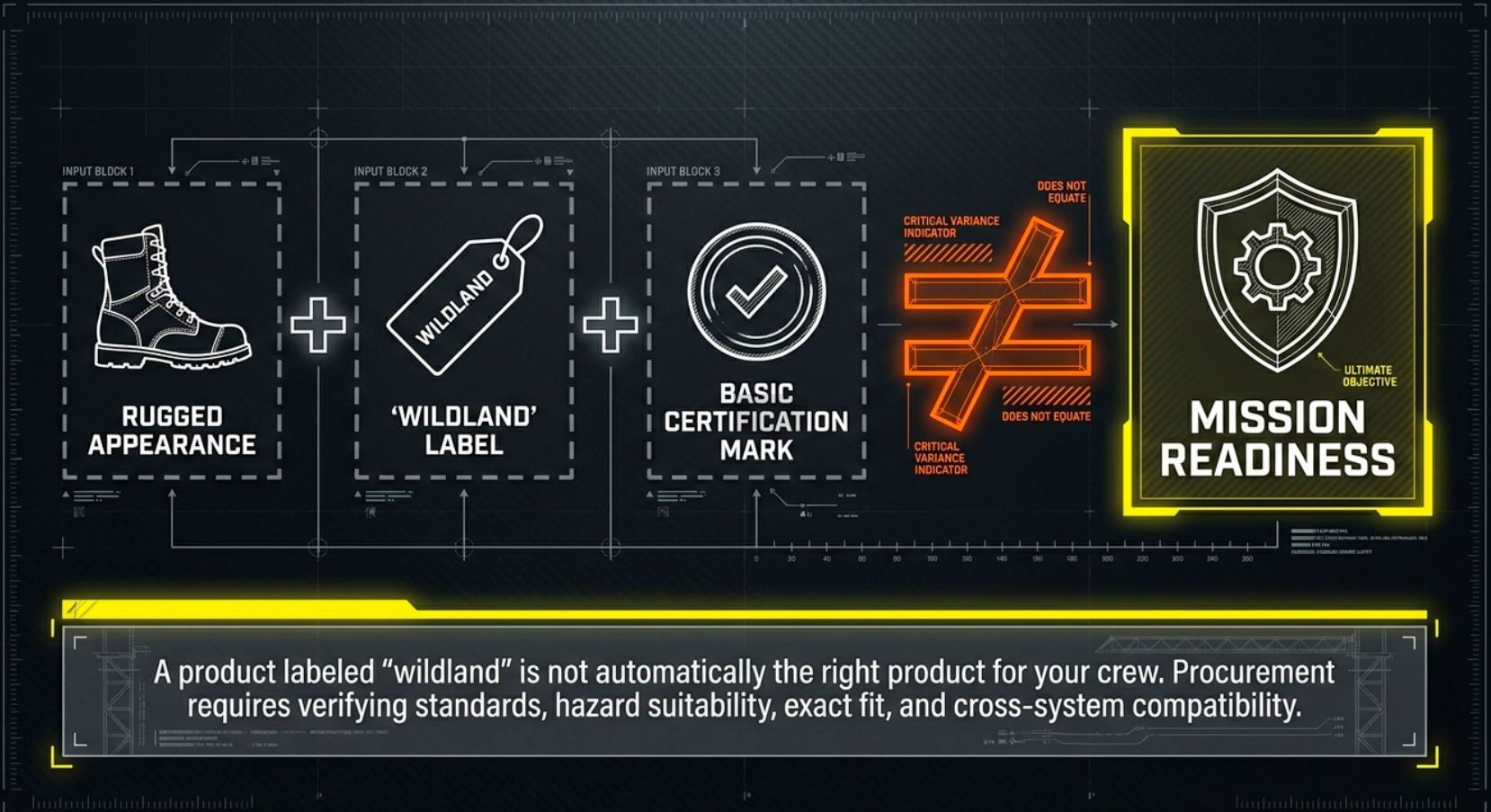
In 2024, an estimated 16,275 firefighter injuries occurred on the fireground in the United States (NFPA). While not all of these incidents involved PPE failures, the statistic underscores why selecting, inspecting, and maintaining the right protective equipment is critical for firefighter safety. A product labeled “wildland” is not automatically the right product for your crew. Wildland PPE requirements involve more than a category name, a rugged appearance, or a certification mark viewed in isolation. Departments need to verify standards, hazard suitability, fit, compatibility, condition, and serviceability across the complete protective system.
Key Takeaways
- Wildland gloves must fit correctly, match the hazards encountered, and support the tools and duties assigned to the firefighter.
- Wildland boots require more than leather construction or an aggressive sole. Departments need to verify standards, fit, traction, support, care requirements, and replacement criteria.
- Certification establishes a starting point. Department-specific risk assessment, field evaluation, inspection, and documentation remain necessary.
Understanding Wildland PPE Requirements
Wildland PPE requirements cover the clothing and equipment firefighters use when exposed to heat, flame, embers, smoke, debris, tools, rough terrain, and changing environmental conditions.
A complete wildland protective system may include:
- Protective shirts, coats, and pants
- Helmets
- Eye protection
- Ear and neck protection
- Gloves
- Boots
- Chainsaw protection
- Fire shelters
- Load-carrying equipment
Each component performs a different job. The equipment must also work together as one wearable system.
A glove may meet a recognized standard and still be poorly suited to the firefighter’s hand size or assigned tools. A boot may use durable materials and still create problems with fit, ankle support, traction, or long-distance movement. A garment may provide more radiant heat protection while trapping more internally generated heat.
Those tradeoffs matter because wildland firefighting combines external thermal exposure with sustained physical work. Firefighters hike, dig, cut, carry, climb, and operate equipment while wearing protective gear. The equipment must provide needed protection without creating avoidable restrictions or excessive heat burden.
NFPA 1977 has historically served as a central standard for wildland protective clothing and equipment. Departments should confirm the current edition, current product certification, and any state or local requirements before writing specifications or issuing a purchase order.
California provides a useful example of how specific those requirements may become. Section 3410.1, operative January 1, 2023, required protective gloves to be properly sized and suitable for the hazards encountered. It also required protective footwear during wildland firefighting activities. Departments operating under California rules should verify the current regulatory text before procurement.
The practical lesson applies everywhere. A department should define the hazard first, then select the equipment.
Why Wildland PPE Requirements Matter for Firefighting
Mission readiness
Wildland incidents expose equipment weaknesses quickly.
A cracked glove, worn palm, damaged stitch, loose boot sole, or poor fit may seem minor during inspection. On steep ground or during extended tool work, the same defect may affect grip, footing, movement, or endurance.
Readiness requires more than confirming each firefighter has gloves and boots assigned. The department also needs to know:
- The equipment fits the firefighter
- The product matches the assigned work
- The condition remains serviceable
- The certification documentation is current
- The equipment works with the rest of the PPE system
- The department has a clear replacement process
Equipment on a shelf is not the same as equipment ready for field use.
Personnel safety
Hands and feet perform most of the physical work during wildland operations.
Firefighters use hand tools, move hose, handle equipment, clear vegetation, carry loads, and cross unstable terrain. Gloves need to protect the hand and wrist while preserving enough movement and grip for the assigned task. Boots need to support movement while maintaining traction, stability, and fit through long shifts.
Improper sizing creates an avoidable problem. A glove that is too loose may reduce control. A glove that is too tight may restrict movement. Poor boot fit may affect balance, comfort, or the firefighter’s ability to continue working effectively.
Fit should be treated as part of equipment performance, not a secondary preference.
Heat exposure and physical workload
Wildland PPE has to address two different heat problems.
External heat may cause burn injury. Internal heat comes from physical exertion. Increasing protection against external heat often reduces the rate at which body heat escapes.
Historical wildland PPE testing illustrates the tradeoff. One 5.0-ounce single-layer fabric configuration produced an RPP value of 7.7 seconds and a THL value of 759 W/m2. When combined with a 7.0-ounce uniform pant fabric, RPP increased to 13.3 seconds while THL fell to 500 W/m2.
RPP refers to Radiant Protection Performance. Higher values indicate more time before a second-degree burn threshold under the specified test conditions. THL refers to Total Heat Loss. Higher values indicate greater ability to release heat through insulation and evaporation.
The numbers are historical and should not be used as current compliance requirements without verification. They still demonstrate an important procurement principle. More layers may increase radiant protection while reducing heat transfer.
Gloves and boots introduce their own heat and moisture concerns. Buyers should review breathability, drying, material construction, and how the product performs during long-duration use. Marketing terms alone do not answer those questions.
Liability and procurement records
Departments should be able to explain why a product was selected.
A defensible procurement file should identify:
- The hazards being addressed
- The applicable standard and edition
- The product model reviewed
- The certification documents received
- The fit process used
- The compatibility checks completed
- The inspection and replacement criteria
- The field evaluation performed
A specification copied from another department may not reflect your operating area, terrain, climate, staffing model, or assignments. Shared mutual-aid responsibilities may create similar needs, but they do not eliminate the need for your own review.
Long-term value
The lowest purchase price may not represent the lowest operating burden.
Wildland PPE requires inspection, cleaning, storage, repair decisions, and replacement planning. Departments need to understand whether components are repairable, how often they should be inspected, and what conditions require removal from service.
Useful questions include:
- Are replacement parts available?
- Are repairs authorized by the manufacturer?
- What damage is acceptable?
- What damage requires retirement?
- How should the product be cleaned?
- How should the product be stored?
- How is age or service history tracked?
Without those answers, departments may replace equipment too late or discard equipment without a consistent standard.
Common Challenges, Risks, or Buyer Mistakes
Buying from the category name
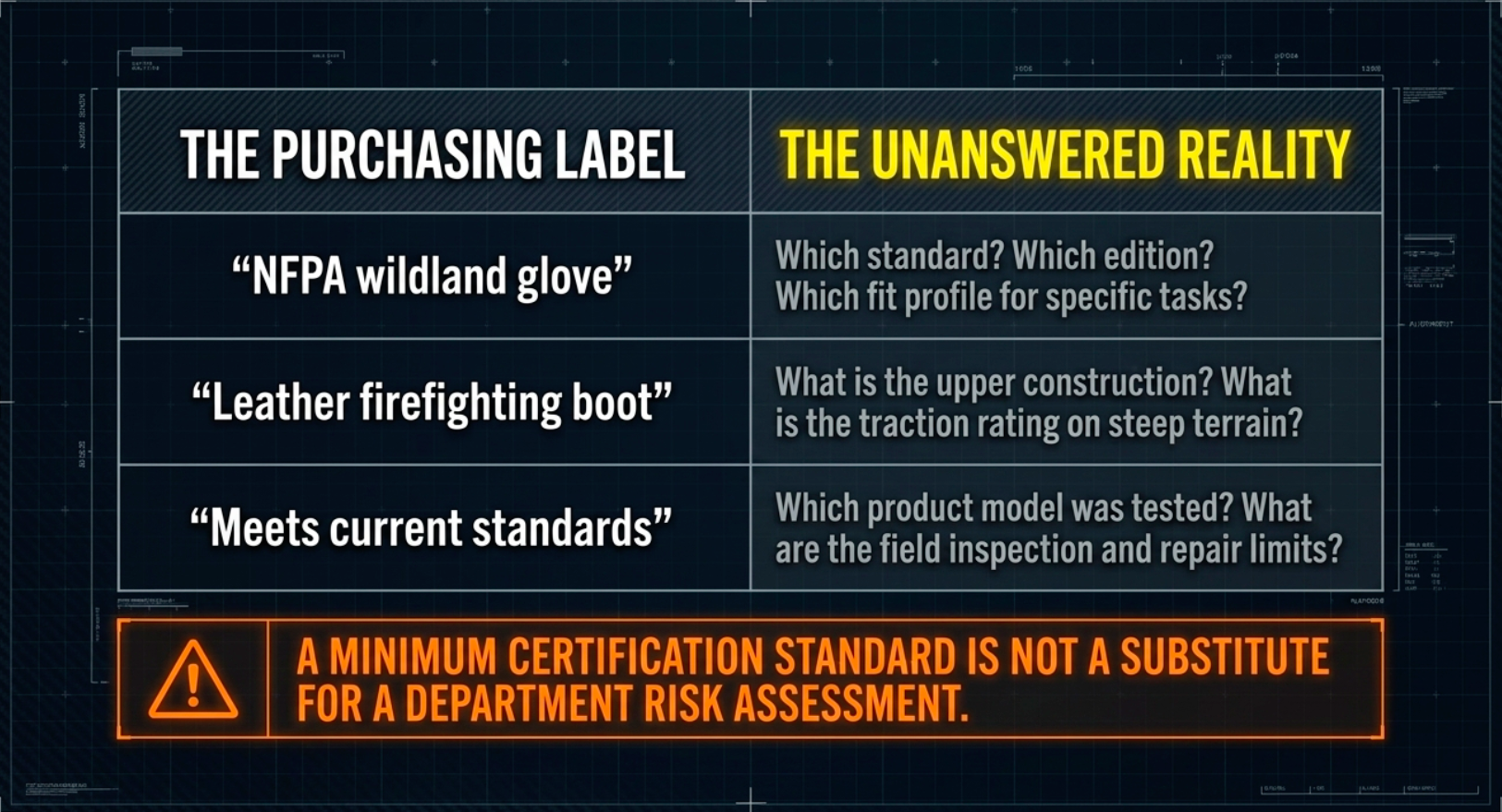
“Wildland glove” and “wildland boot” are incomplete specifications.
Those labels do not confirm:
- The applicable standard
- The certification edition
- The product’s intended task
- The size range
- The fit process
- The inspection limits
- The repair policy
- The replacement criteria
Procurement teams should require exact model documentation.
Treating certification as the final decision
Certification confirms defined requirements under specified test conditions. It does not prove the product is the best operational fit for every department.
Wildland PPE needs vary with:
- Terrain
- Climate
- Fuel type
- Operational role
- Workload
- Travel distance
- Vehicle access
- Department experience
- Known injury patterns
A department working near vehicle-accessible WUI areas may have different needs from a crew walking into remote mountainous terrain. WUI PPE requirements should reflect the work performed, not only the incident classification.
Ignoring glove fit and tool use
Gloves should be tested with the equipment firefighters will use.
That includes:
- Pulaskis
- McLeods
- Shovels
- Hose
- Radios
- Pack straps
- Saw support tasks
- Other department-specific tools
The glove must support movement, grip, and wrist coverage without interfering with the sleeve or other equipment.
Inspection should include:
- Holes
- Thinning material
- Cracks
- Brittleness
- Worn palms
- Damaged stitching
- Cuff damage
- Closure damage
The manufacturer should provide the final repair and retirement criteria.
Treating all leather boots as equivalent
Leather construction does not establish complete wildland suitability.
Departments should verify:
- Boot height
- Upper material
- Sole construction
- Traction
- Heat-related performance
- Ankle support
- Toe construction
- Lacing system
- Width availability
- Applicable certification
- Care requirements
Some historical recommendations reference leather boots, ankle support, lug-style soles, and specific height requirements. Those points should be checked against the current standard and the exact product documentation before they become bid requirements.
Skipping realistic fit evaluation
Trying on equipment in a station does not reproduce field conditions.
Boots should be evaluated during walking, climbing, crouching, tool work, and movement with a loaded pack. Gloves should be evaluated during gripping, lifting, pulling, and handling the tools used by the department.
A short fit check may identify an obvious size problem. A field assessment identifies operational problems.
Ignoring compatibility
PPE components do not operate independently.
Gloves must work with:
- Shirt or coat sleeves
- Wrist closures
- Hand tools
- Radio controls
- Pack straps
Boots must work with:
- Wildland trousers
- Socks
- Gaiters where used
- Vehicle entry and exit
- Turnout gear where dual-role operations require overlap
- The terrain encountered by the department
A product may perform well by itself and still create a problem inside the full equipment system.
Current Operational Gaps
Many departments verify equipment at the time of purchase, then rely on informal inspection after issue.
That creates gaps in several areas.
First, certification applies to a defined product condition and test method. Field equipment is exposed to wear, moisture, dirt, heat, repeated use, and cleaning. Departments need a process for deciding when field condition no longer matches acceptable serviceability.
Second, fit may vary across the workforce. A product offered in broad size categories may not fit every firefighter equally well. Women firefighters and personnel outside common sizing ranges may face greater fit challenges.
Third, maintenance guidance is often separated from procurement. The buying committee selects the product, while operations personnel later determine how to clean, inspect, repair, and replace it.
Those functions should be connected before the purchase.
A complete procurement plan should answer:
- Who inspects the equipment?
- How often is it inspected?
- How is damage documented?
- Which repairs are allowed?
- Who approves return to service?
- What triggers replacement?
- Are spare sizes available?
- Is the replacement model still certified to the same requirement?
These are operational questions with procurement consequences.
The Hunter Apparatus Solution
At Hunter Apparatus, we help departments evaluate fire and EMS equipment against the work their crews perform.
For wildland gloves and boots, we start with the use case. We look at the hazard, terrain, duty, fit range, compatibility needs, maintenance expectations, and documentation required by the department.
Our review focuses on practical questions:
- What standard applies?
- Which edition applies?
- Is the exact model documented?
- Does the size range cover the crew?
- Will the glove support assigned tools?
- Will the boot support the operating terrain?
- What inspection guidance is available?
- What replacement criteria are provided?
- How does the equipment fit with the rest of the PPE system?
We do not treat a product label as proof of suitability. We also do not assume equipment selected by another department will match your needs.

The Hunter Standard
We evaluate equipment against the department’s actual need.
Our standard is practical verification. We look for current product documentation, real-world fit, operational compatibility, inspection guidance, serviceability, and clear replacement criteria.
For gloves and boots, we want to know how the product will be used, who will wear it, where the crew will operate, and how the department will maintain it.
We also separate confirmed specifications from assumptions. When certification, availability, or performance data is unclear, we ask for documentation before making a recommendation.
That process supports clearer bids, stronger procurement records, and equipment decisions based on actual operations.
Technical Evaluation and Buying Considerations
Start with a risk assessment
Define the operating threat before selecting products.
Your assessment should consider:
- Duties performed
- Expected heat exposure
- Terrain
- Climate
- Fuel type
- Direct or indirect attack roles
- Tool use
- Vehicle access
- Duration of operations
- Existing PPE configuration
- Department experience
Document the assessment and revise it when operating conditions or lessons learned change.
Build an operational requirements document
A written requirements document creates a baseline for evaluation.
Separate key requirements from preferences.
Key requirements may include:
- Applicable certification
- Hazard suitability
- Size range
- Fit
- Compatibility
- Inspection guidance
- Replacement criteria
Preferences may include:
- Color
- Appearance
- Pocket configuration
- Brand continuity
The department should decide which requirements are mandatory before reviewing products.
Evaluate wildland gloves
Verify:
- Exact model
- Certification
- Standard edition
- Material
- Size range
- Fit method
- Wrist and cuff coverage
- Grip
- Dexterity
- Task suitability
- Cleaning instructions
- Inspection guidance
- Repair policy
- Retirement criteria
Avoid assuming one glove should cover every assignment. General tool work and direct thermal exposure may create different requirements.
Evaluate wildland boots
Verify:
- Exact model
- Certification
- Standard edition
- Height
- Upper construction
- Sole construction
- Traction
- Ankle support
- Toe design
- Size and width range
- Lacing system
- Cleaning requirements
- Conditioning requirements
- Resoling policy
- Inspection criteria
- Retirement criteria
The boot should be assessed under realistic movement and load.
Request supporting documentation
Ask for:
- Certification records
- Product data sheets
- Test data where applicable
- Manufacturer care instructions
- Inspection procedures
- Repair limits
- Replacement criteria
- Current model information
When your department requires performance above a minimum standard, request objective test data supporting the higher requirement.
Conduct an operational assessment
Use multiple firefighters where possible.
Evaluate:
- Fit
- Comfort
- Range of motion
- Grip
- Traction
- Tool control
- Donning
- Removal
- Compatibility
- Early wear
The product with the strongest laboratory value may not be the product with the best field fit. Both forms of evaluation matter.
Conclusion: Wildland PPE Requirements
Wildland PPE requirements should produce a complete, documented protective system. They should not produce a generic list of gloves, boots, garments, and accessories.
Gloves need proper fit, hazard suitability, tool compatibility, and clear retirement criteria. Boots need verified construction, support, traction, fit, care guidance, and current standards documentation. The full system should be evaluated under the conditions your firefighters will face.
Contact Hunter Apparatus to review your wildland glove and boot requirements, fit needs, compatibility concerns, and procurement documentation before your next purchase.
FAQs About Wildland PPE Requirements
In This Article
- Key Takeaways
- Understanding Wildland PPE Requirements
- Why Wildland PPE Requirements Matter for Firefighting
- Common Challenges, Risks, or Buyer Mistakes
- Current Operational Gaps
- The Hunter Apparatus Solution
- The Hunter Standard
- Technical Evaluation and Buying Considerations
- Conclusion: Wildland PPE Requirements
- FAQs About Wildland PPE Requirements
- Reliability You Can Count On. Peace of Mind You Can Trust