
Do Departments Provide All Required Gloves?
A department-issued pair of structural gloves does not cover every job a firefighter may face. NFPA estimates that U.S. municipal firefighters suffered an average of 20,480 nonfatal fireground injuries each year from 2020 through 2024, with 15% involving the upper extremities. That makes hand and arm protection a real part of fireground readiness.
So, the question “Do Departments Provide All Required Gloves” needs more than a yes or no answer. Structural PPE, rescue gloves, wildland gloves, hazmat gloves, and personal gear serve different roles. A strong glove program matches the glove to the job, the hazard, and the firefighter.
Key Takeaways
- Departments usually issue structural gloves, but other glove policies vary.
- Personal gloves should be approved before use on calls.
- Fit, wet-hand use, cleaning, and replacement planning all matter.
Understanding Do Departments Provide All Required Gloves
Fire departments generally provide the PPE needed for structural firefighting. Structural gloves are usually part of that gear.
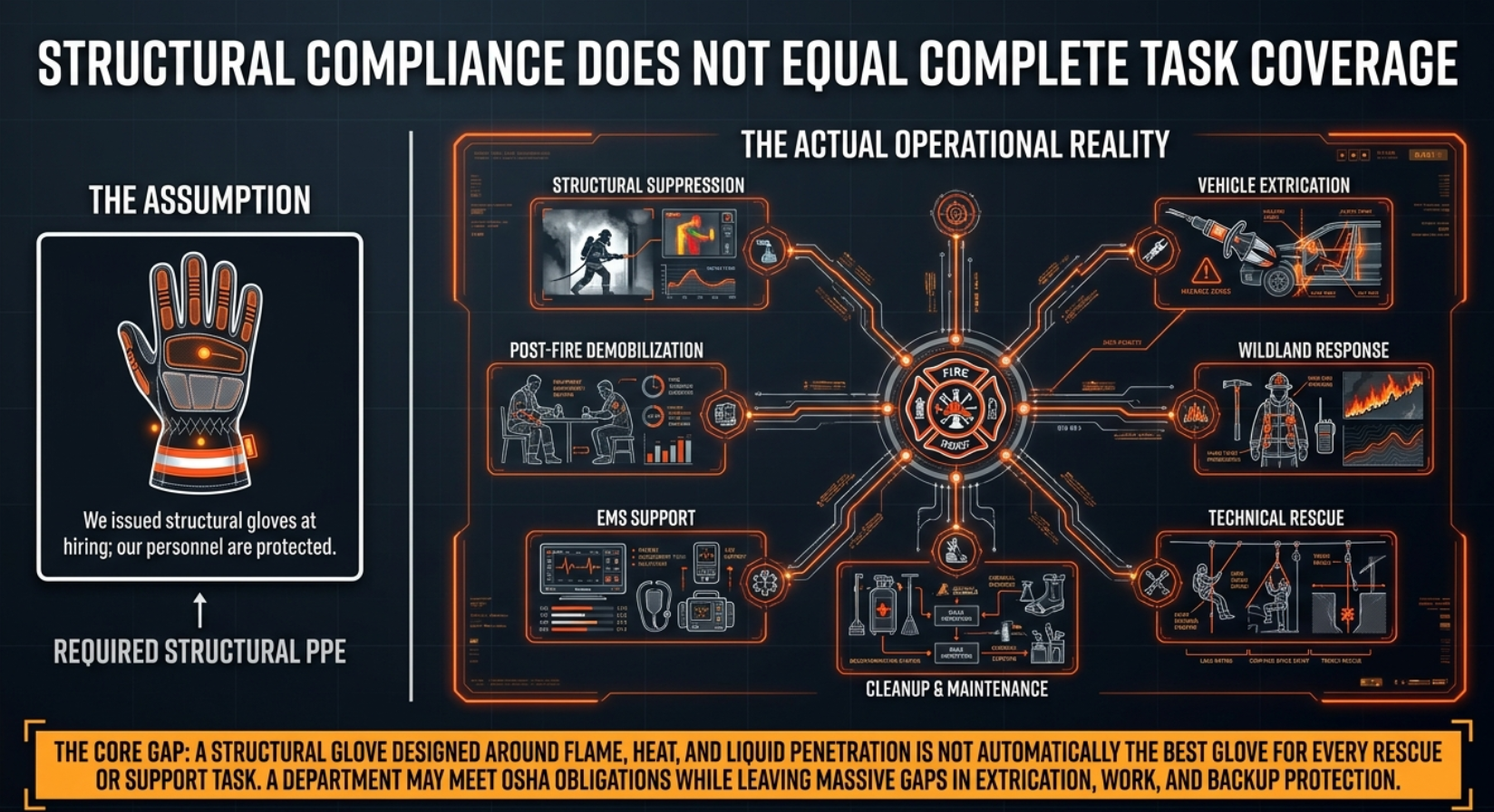
Still, one pair does not cover every task.
Firefighters may work structure fires, vehicle crashes, wildland fires, rescue calls, hazmat events, medical calls, and cleanup. Each job puts different demands on the hands.
Structural gloves are made for structural fire hazards. Extrication gloves focus more on sharp debris and tool use. Wildland gloves support work around heat, embers, brush, and flame. Hazmat gloves need to match the chemical risk.
That means departments should decide which glove fits each job.
Before buying personal gloves, firefighters should know what the department issues. They should also know which gloves are approved, who cleans them, who inspects them, and whether backup pairs are available.
A department may cover structural PPE and still have gaps in other areas. Rescue, wildland, hazmat, cleanup, and backup needs should be reviewed on their own.
Why Department-Provided Gloves Matter
Mission Readiness Starts With the Right Glove
The right glove helps a firefighter stay ready for the task.
Structural gloves often use an outer shell, moisture barrier, and thermal barrier. These layers help protect against heat, flame, liquid, cuts, and punctures. They also add bulk.
Extrication work is different. Firefighters may work around broken glass, sharp metal, debris, and rescue tools. They need protection, but they also need good hand control.
Wildland work has its own needs. Crews may work for long periods around heat, embers, brush, and rough ground.
One glove may not work well for every job.
Departments also need a backup plan. A main pair may be wet, dirty, damaged, or being cleaned. A clean replacement should be ready when needed.
Fit Matters in the Field
A glove only works if the firefighter can wear it and keep it on.
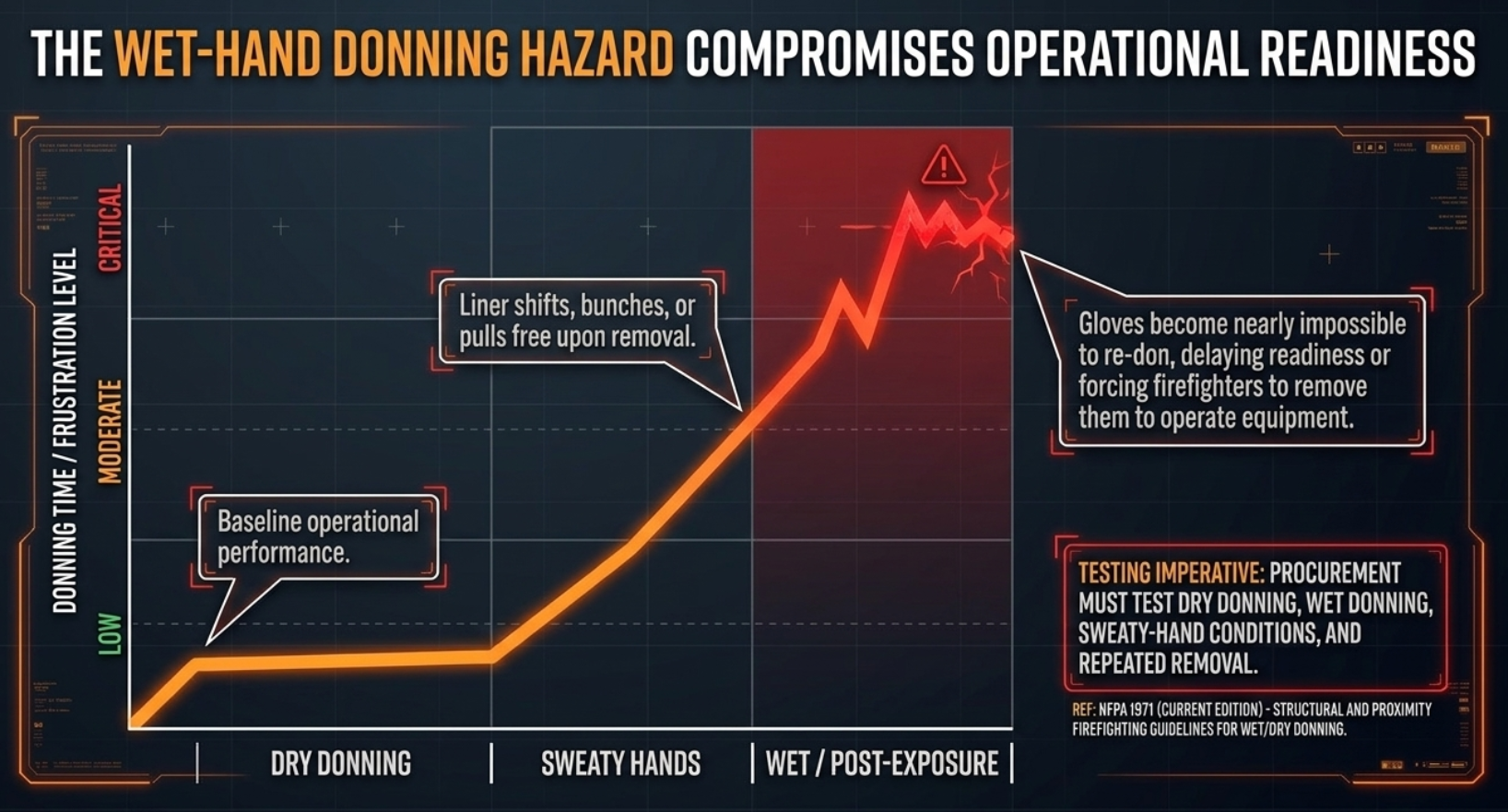
Fit problems are common. Some gloves are hard to put on with wet or sweaty hands. Some liners move or pull out. Other gloves may become loose, tight, or hard to use after washing.
Poor finger control also matters.
Firefighters may need to use a radio, handle hose, reach into a pocket, connect gear, or use rescue tools. If the glove makes those jobs too hard, the firefighter may remove it.
That creates a gap in hand protection.
Certification matters, but fit matters too. Departments should test the exact glove and size during real tasks.
Personal Gloves Need Department Approval
A firefighter may like a glove more than the department-issued pair. That does not make the personal glove approved PPE.
Before a personal glove is used on a call, the department should review the exact model. The team should confirm its approved use, fit, care needs, and required certification.
The department should also decide who cleans, inspects, and replaces the glove.
A glove may feel thinner or easier to put on. That does not prove it is right for structural firefighting.
The mission still comes first.
Common Challenges and Buyer Mistakes
Assuming One Pair Covers Every Job
Required structural PPE does not always cover every task.
A department may issue structural gloves but use other gloves for rescue, brush work, maintenance, or cleanup.
Each glove should have a clear role.
Departments should know which gloves are required PPE, which are approved add-on PPE, which are personal gear, and which are not allowed on calls.
Clear rules reduce guesswork.
Treating All Firefighter Gloves the Same
Not every fire-service glove is made for the same job.
Work gloves may be fine for maintenance. They are not structural firefighting gloves.
Extrication gloves may give good tool control and sharp-debris protection. That does not prove they have the heat protection needed for interior fire work.
Wildland gloves may offer good movement and fast donning. That does not make them structural gloves.
Start with the job. Then choose the glove type.
Ignoring Wet-Hand Donning
A glove should not be tested only with dry hands.
Firefighters sweat. Gloves get wet. Crews may also remove gloves during a call and need to put them back on.
That makes wet-hand donning a key test.
Departments should check dry use, wet use, repeated removal, liner movement, cuff fit, and fit after cleaning.
A glove may feel good once it is on. It still creates a problem if it is hard to put back on.
Buying Based Only on First Fit
The first fitting is only the start.
A glove may change after use, washing, drying, or decon. Some gloves may stretch. Others may tighten.
Departments should test fit over time.
Start with the maker’s size chart. Then test the glove during normal work.
Do not buy a smaller size just because someone says the glove may stretch.
Overlooking Different Hand Shapes
Firefighters do not all have the same hands.
Some have short fingers. Others have long fingers or wide palms. Some need more palm room without more finger length.
A good fit check should look at finger length, palm size, hand length, thumb position, and cuff fit.
Cadet sizes may help some users when offered.
The goal is simple. Fit the glove to the firefighter.
Changing the Glove to Make It Fit
Firefighters should not remove liners or change glove parts just to make the glove easier to wear.
A structural glove works as a full system. The shell, barriers, liner, stitching, and cuff all have a job.
If the glove does not work in its approved form, the better choice is to review the fit or choose another approved model.
Buying Without a Backup Plan
Gloves wear out.
They also get wet, dirty, damaged, or sent for cleaning.
Departments should plan for main pairs, backup pairs, other glove types, replacement sizes, new hires, and damaged gear.
Buying the first pair is only part of the job.
Current Operational Gaps
Many departments still treat gloves as a one-time PPE purchase.
The gloves are bought, fitted, and placed in service. Then the real problems show up.
Firefighters may report tight cuffs, poor finger control, liner movement, wet-hand donning issues, shrinking, or stretching.
Without a clear process, members may start buying their own gloves. That may lead to mixed models, poor tracking, or gear that was never approved.
Cleanup and nonfire work create another issue.
A firefighter may use structural gloves for one task and work gloves for another. Rescue work may need a different glove. Medical calls may need another type again.
The answer is not to force one glove into every role.
A better glove program links the hazard, glove type, fit, certification, field testing, cleaning, inspection, backup stock, and replacement.
Technical Evaluation and Buying Considerations
Confirm the Job
Start with the task, not the brand.
Decide whether the glove is for structural fire work, vehicle rescue, technical rescue, wildland response, cleanup, maintenance, or hazmat work.
Then look at gloves made for that role.
A material name alone does not prove the glove is right for the job.
Verify the Exact Certification
Review the exact model and its approved use.
Also check the size range, cuff style, standard, standard edition, and certification details.
The product being bought should match the product documents.
For example, the Penelope Plus Green is an extrication and rescue glove. Its EN 388 and EN 407 ratings should not be treated as proof of structural fire approval.
Review the Glove Build
Look at the whole glove.
For structural gloves, review the outer shell, moisture barrier, thermal barrier, liner, stitching, cuff, and test data.
For extrication gloves, the focus is different.
The Penelope Plus Green uses a goatskin palm, stretch fabric on the back, TPR impact protection, leather fingertip support, and added material between the thumb and index finger.
These details give departments clear points to compare with rescue work.
Test Fit Across the Crew
Do not test one glove on one person.
Include firefighters with small hands, large hands, short fingers, long fingers, narrow palms, and wide palms.
Then have them do real tasks.
The Penelope Plus Green comes in sizes from XS to 3XL.
That gives departments a clear size range to test.
Test Wet and Dry Donning
Have firefighters put the gloves on and remove them with dry hands.
Then repeat the test with wet hands.
Watch for liner movement, bunching, twisting, poor finger fit, or a wrist closure that slows the process.
A glove may protect well but still be a poor fit if it is hard to put back on.
Review Care Needs
Care should be part of the buying choice.
Check washing rules, detergent limits, drying rules, inspection steps, repair limits, and retirement rules.
For the Penelope Plus Green, machine washing is allowed up to 104°F with mild detergent. Bleach should not be used. The glove should be hang dried.
Add those care rules to department procedures.
Plan for Replacement
A glove program also needs a replacement plan.
Know which sizes your department needs. Decide how damaged gloves will be replaced. Keep enough stock to cover cleaning, loss, damage, and new hires.
Do not wait for a failed glove to start that process.
The Hunter Apparatus Solution
Hunter Apparatus provides fire and EMS departments with apparatus, PPE, equipment, and buying support. Holik is one of the PPE lines we offer.
Our process starts with the job.
Structural fire work, rescue, extrication, and wildland response do not place the same demands on the hands. So, departments should review each Holik model for its intended role.
One example is the Holik Penelope Plus Green. It is made for extrication and rescue work.
The palm uses goatskin leather. The back uses a breathable stretch fabric. TPR covers the knuckles and the back of the hand. The palm liner uses Kevlar, polyester, and fiberglass.
The glove also adds leather at the fingertips and extra material between the thumb and index finger.
The Penelope Plus Green carries EN 388:2016+A1:2018 ratings for mechanical protection. It has level 3 abrasion resistance, level 4 tear resistance, level 3 puncture resistance, level C cut resistance, and P impact protection on the back of the hand.
It also has EN 407:2020 contact heat protection in the palm.
Sizes run from XS to 3XL.
Those details help define the glove’s role. Penelope Plus Green is an extrication and rescue glove. It should be judged for that work, not as proof that one Holik glove fits every mission.
Care also matters.
The Penelope Plus Green may be machine washed up to 104°F with mild detergent. Do not use bleach. Hang dry the glove instead of using a tumble dryer.
These points matter before the glove enters service.
Departments should also involve firefighters in field tests. Members should use the glove during tasks they perform on calls.
That may include radio use, tool work, gear handling, pocket access, and wet-hand donning.
Different hand sizes should also be part of the test.
Our goal is to help departments match the glove to the job.

Our Standard
We base our standard on practical checks.
First, we confirm the mission. Then we review fit, product documents, field use, care needs, and replacement planning.
We ask whether the glove is made for the job and whether the size fits the firefighter. We also check whether members can complete tasks without removing the glove.
Wet-hand donning matters too. So do cuff fit, liner movement, cleaning needs, and replacement planning.
For a glove such as the Penelope Plus Green, the size range, wrist closure, impact protection, heat rating, and care rules give the department clear points to test.
The goal is not to find one glove for every job.
The goal is to choose the right glove, know its limits, and support it after purchase.
Conclusion: Do Departments Provide All Required Gloves
Do Departments Provide All Required Gloves? Departments usually provide required structural PPE, but rules for rescue, wildland, hazmat, utility, and backup gloves vary.
The better question is whether your firefighters have the right approved glove for each job.
Start with the mission. Then check the product, fit, certification, wet-hand use, care needs, and replacement plan.
Hunter Apparatus offers Holik gloves and works with fire and rescue departments on PPE selection. Contact Hunter Apparatus to review glove options for your department.
FAQs About Do Departments Provide All Required Gloves
In This Article