
What Equipment Do I Need for My Ambulance?
A safe ambulance needs more than a basic gear list. It needs the right tools, clear storage, and a layout that helps crews move fast. Each item should be easy to find and every device should stay locked in place while the unit is moving. This helps protect the crew, the patient, and the agency.
This guide explains the main tools most ambulances need. It covers basic life support, advanced life support, safe mounting, and cleaning needs.
Key Takeaways
- Ambulance gear should be split into basic life support and advanced life support groups.
- Heavy tools, such as monitors and vents, should be held by tested mounts so they do not move during a call.
- Pediatric care should use length-based guides to help reduce drug dose mistakes.
Basic Life Support Inventory Parameters
Basic life support, or BLS, is the first level of care for many EMS calls. A BLS unit needs tools for airways, oxygen, bleeding, splints, patient moves, and basic checks. The exact list can change by state and local rule. Your medical director may also set extra needs. Still, most BLS units share the same core groups of gear.
Airway Management and Resuscitation Hardware
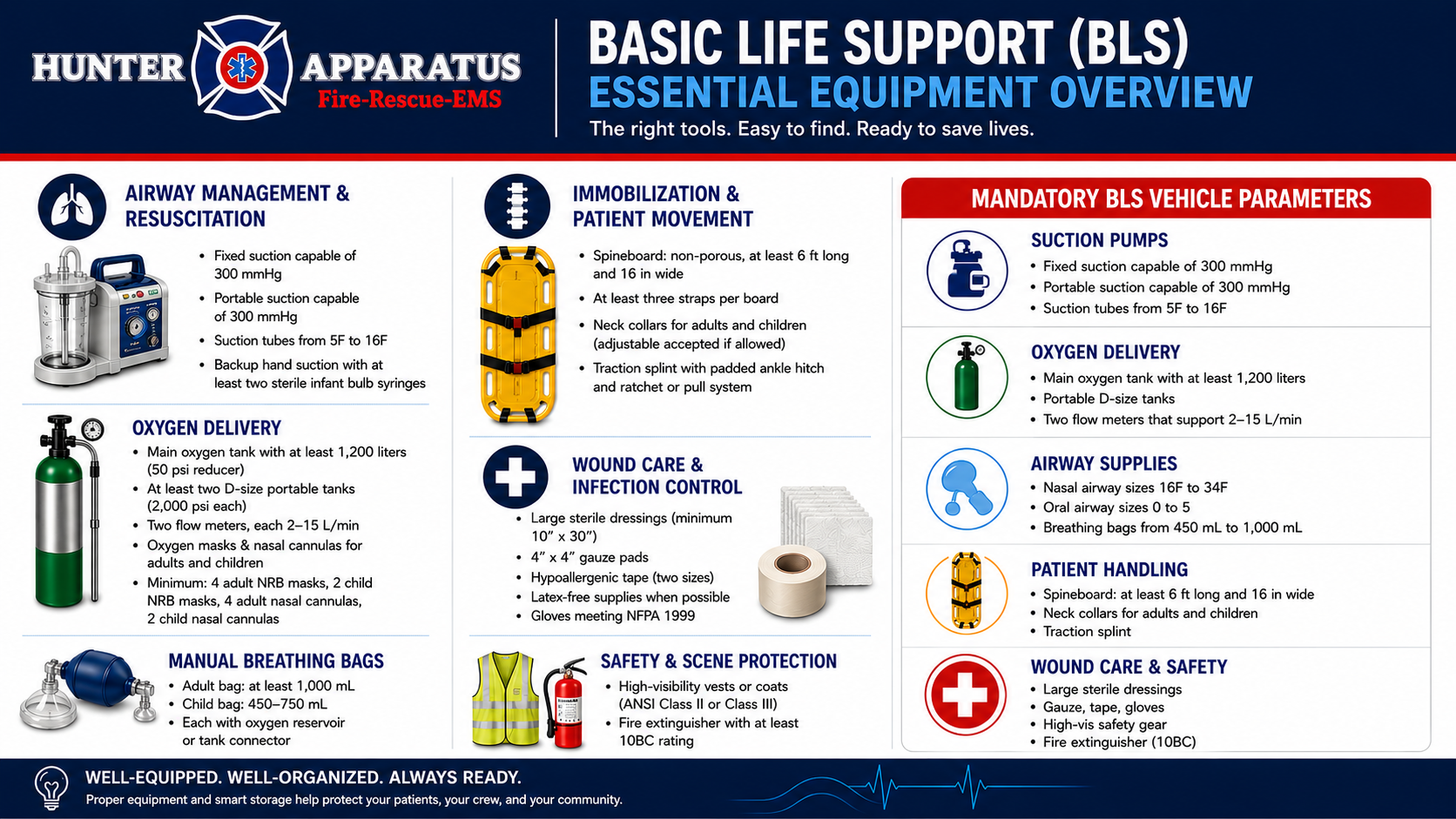
Airway gear should be checked first. Crews need tools that can clear the mouth and throat, help a patient breathe, and give oxygen fast. The ambulance should have fixed suction and portable suction. Each suction unit should pull at least 300 mmHg when the suction line is blocked. The unit should also carry rigid suction tips and soft suction tubes. Common tube sizes include 5F to 10F and 6F to 16F. A backup hand suction setup should be on board. It should include at least two sterile infant bulb syringes. These are used for newborn airway care.
Oxygen gear is another core need. Portable oxygen should include at least two D-size tanks. Each tank should have at least 2,000 psi. The main oxygen tank should hold at least 1,200 liters. It should use a 50 psi reducer. It should also feed two flow meters at the same time. Each flow meter should allow up to 15 liters per minute.
The unit should carry oxygen masks and nasal tubes for adults and children. A common minimum is four adult non-rebreather masks, two child non-rebreather masks, four adult nasal cannulas, and two child nasal cannulas. Manual breathing bags are also required. Adult bags should hold at least 1,000 mL. Child bags should hold about 450 mL to 750 mL. Each bag should have an oxygen bag or tank link. The airway kit should include nasal airways from 16F to 34F. It should also include oral airways in sizes 0 through 5.
Immobilization, Wound Care, and Safety Supplies
Crews also need tools to move and hold patients safely. Spineboards should be non-porous. They should be at least 6 feet long and 16 inches wide. Each board should have at least three straps. The ambulance should carry neck collars for adults and children. Adjustable collars may be used if they meet local rules. For serious leg injuries, the unit should carry a traction splint. It should have a padded ankle hitch and a ratchet or pull system.
Wound care supplies should include large sterile dressings. A common size is at least 10 inches by 30 inches. The unit should also carry 4 inch by 4 inch gauze pads and hypoallergenic tape in two sizes. Infection control matters on every call. When possible, tools and supplies should be latex free. Gloves should meet NFPA 1999. This helps protect crews from blood, body fluids, and some chemical risks. Crews also need high-vis safety vests or coats for road calls. These should meet ANSI Class II or Class III rules. The unit should also carry a working fire extinguisher with at least a 10BC rating.
Advanced Life Support System Specifications
Advanced life support, or ALS, builds on the BLS list. ALS units add more tools for airway care, IV access, heart care, drug use, and close patient checks. ALS gear must be sorted well. Crews need to find the right size fast. They also need clear storage for drugs and high-value tools.
Invasive Airway Management and Circulation Supplies
An ALS airway kit should include a full laryngoscope set. This means a working handle, spare batteries, straight Miller blades in sizes 0 through 4, and curved MacIntosh blades in sizes 2 through 4. The kit should also carry endotracheal tubes. It should include at least two of each needed size. Uncuffed tubes often run from 2.5 mm to 5.5 mm. Cuffed tubes often run from 6.0 mm to 8.0 mm.
Crews also need a way to confirm tube placement. End-tidal CO2 tools can help. These may be color-change tools or numeric capnography tools. IV supplies should include fluid bags, microdrip sets, and macrodrip sets. The unit should carry at least four 1,000 mL fluid bags. Glass bottles should not be used. The unit should also carry IV catheters from 14G to 24G. For chest decompression, ALS units should carry large-bore needle kits. For adults, the needle should usually be at least 3.25 inches long.
Advanced Diagnostic Monitoring and Field Pharmacology
ALS units need a battery-powered heart monitor. The monitor should support external pacing. It should include quick-look paddles or hands-free pads. It should also include adult and child pads. The unit should also carry a blood sugar meter and usable test strips. Drug storage should follow current American Heart Association guidance and local medical rules.
Common ALS drugs may include epinephrine, amiodarone, nitroglycerin, and 50% dextrose. For children, the unit should also carry 25% dextrose when required by protocol. Drug dosing should be simple and clear. This is most important for child patients. Crews should use tools that reduce math during stress.

Integration Strategies and Decontamination Challenges
An ambulance can have the right gear and still fail in the field. Poor layout, weak mounts, and slow cleaning can all create risk. Crews should be able to reach life-saving tools without digging through loose bins. Devices should stay locked in place during turns, stops, and rough roads.
Vehicle Structural Strain and Latch Failures
Ambulance interiors take a lot of abuse. They face vibration, hard stops, sharp turns, and heavy daily use. Over time, cabinet latches, tracks, mounts, and storage boxes can wear down. A weak latch can let gear shift or fall. A loose monitor can become a hazard. Your service should check these parts often. Review mounts, brackets, cabinet doors, tracks, and straps. Replace worn parts before they fail during a call.
Biological Contamination Tracking
Ambulances are exposed to blood, body fluids, air particles, and other bio hazards. Seams, rough surfaces, and tight spaces can trap germs. This makes fast cleaning harder between calls. A good cleaning plan should cover both air and surfaces. Automated cleaning systems can help reduce this risk. They can support air and surface cleaning while limiting downtime.
The Hunter Apparatus Standard
Before your agency issues an RFP or buys new gear, review the ambulance layout. The vehicle should support patient care, crew safety, and secure storage. Hunter Apparatus was founded in 2019 to help public safety teams buy and build better emergency vehicles.
We look at the ambulance as one full system. Power, storage, device mounts, and cleaning should all work together. Our team helps protect high-value medical tools from power issues. We build heavy-duty module layouts that support stable power for sensitive devices.
We also help reduce loose-device hazards. Monitors, ventilators, and infusion pumps can be locked into tested aluminum tracks. These systems support rotation, quick release, and secure hold while the unit is moving. We can also add trace hydrogen peroxide systems into the ambulance cabin. These systems help clean air and surfaces with less manual work and less vehicle downtime.
Contact Our Team
Do not leave your crews exposed to loose equipment, outdated layouts, or weak storage systems. Contact Hunter Apparatus today to schedule a fleet review and discuss your ambulance needs.
Conclusion: What Equipment Do I Need for My Ambulance
A strong ambulance setup starts with the right gear. It also needs clear storage, safe mounts, and a clean cabin. Fire and EMS leaders should make sure each BLS and ALS unit is complete, easy to check, and ready for each shift. A better layout can help reduce risk, speed up response, and protect your crew.
Request a quote or spec review from Hunter Apparatus to confirm your ambulance setup and improve fleet readiness.
FAQs About What Equipment Do I Need for My Ambulance
In This Article
- Key Takeaways
- Basic Life Support Inventory Parameters
- Advanced Life Support System Specifications
- Integration Strategies and Decontamination Challenges
- The Hunter Apparatus Standard
- Contact Our Team
- Conclusion: What Equipment Do I Need for My Ambulance
- FAQs About What Equipment Do I Need for My Ambulance
- Reliability You Can Count On. Peace of Mind You Can Trust