
Are Expensive Firefighter Boots Worth It?
A higher price does not automatically make a firefighter boot the right boot. When firefighters ask, “Are expensive firefighter boots worth it,” the better question is whether the added cost buys verified fit, protection, serviceability, and operating value for the calls you actually run. Over seven years, estimated ownership costs can range from $680 to $1,050 for leather boots and $530 to $1,040 for rubber boots (FSUSA), showing how closely long-term costs can overlap despite very different upfront prices. Price matters, but mission profile, construction, maintenance, and wearer fit should drive the final decision.
Key Takeaways
- Premium firefighter boots often add advanced fit systems, moisture barriers, ergonomic footbeds, and repairable construction.
- Rubber boots remain a practical choice for water, contamination, cold-weather, backup, and immediate-deployment needs.
- Departments should compare certification, fit, maintenance, service life, and total ownership cost rather than purchase price alone.
Understanding Whether Expensive Firefighter Boots Are Worth It
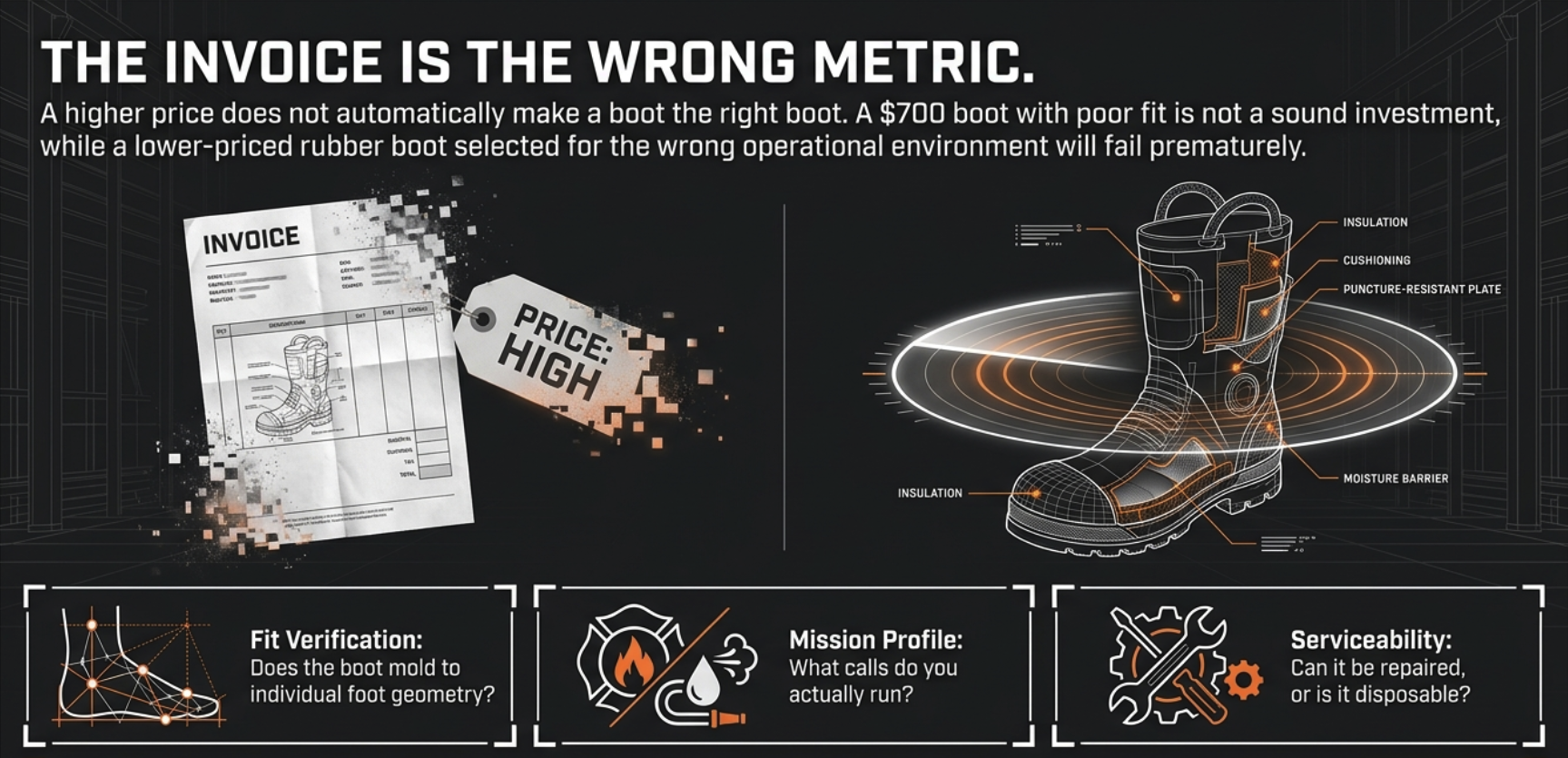
Firefighter boot pricing reflects more than the material used on the outside. A complete boot specification includes the upper, moisture barrier, insulation, shank, puncture plate, safety toe, outsole, heel-retention system, footbed, lining construction, and repair method.
Leather fire boots commonly fall between $400 and $750 per pair. Rubber fire boots commonly fall between $250 and $500. Those ranges create a visible price gap, but the initial invoice does not explain how either boot will fit, perform, wear, or require maintenance.
Leather and rubber firefighter boots both qualify for structural firefighting use when the specific model carries the required certification. That does not mean every certified boot provides the same fit, flexibility, water behavior, chemical resistance, maintenance burden, or service life.
Certification is one part of the evaluation. It should never replace a full review of the boot’s construction and intended application.
The word “expensive” also needs context. A higher-priced boot might include a CROSSTECH moisture barrier, a multi-density footbed, heel-locking geometry, adjustable-width components, or repairable sole construction. Those features only create value when they match the firefighter and the department’s operational environment.
A $700 boot with poor fit is not a sound investment. A lower-priced rubber boot selected for standing water, decontamination, or backup inventory might be the correct operational choice.
Before making a decision, ask:
- What work will the boot support?
- How long will personnel wear it during a shift?
- What contaminants will contact the boot?
- How will the department clean and dry it?
- Does the boot fit the individual firefighter?
- Is the construction repairable?
- What documentation supports the certification and protective claims?
Why Firefighter Boot Value Matters for Firefighters
Your boots affect more than foot comfort. They are part of the protective ensemble and influence how you move, climb, kneel, stand, and work through an incident.
Mission Readiness
Some footwear requires a planned break-in period. Leather boots commonly need two to four weeks of gradual wear before reaching a stable long-term fit. A practical break-in process may begin with short station-duty periods before moving into full-shift wear.
Rubber boots do not require the same break-in period. They are generally ready for immediate issue.
This difference affects deployment planning. A department replacing damaged boots during a shift may value immediate usability. A career firefighter preparing for a long-term issue boot may place more weight on fit development and extended-shift comfort.
A department issuing leather boots should account for:
- Gradual break-in
- Backup footwear
- Fit reassessment
- Initial hot spots
- Drying and conditioning procedures
A department issuing rubber boots should account for:
- Limited fit adaptation
- Heat and perspiration retention
- Full replacement when non-repairable wear occurs
- Potential need for upgraded footbeds
Personnel Safety
Firefighter boots commonly include safety toes, puncture-resistant plates, and steel or composite shanks. Model-level construction still varies.
Fit matters just as much as the presence of protective components. A boot that allows heel movement, creates pressure points, or restricts natural movement may distract the wearer during ladder work, victim movement, confined-space operations, or prolonged overhaul.
Departments should avoid unsupported medical promises. The practical requirement is simpler. Firefighters need secure heel retention, adequate width, stable underfoot support, and enough mobility for the assignment.
Procurement Risk
One of the weakest buying assumptions is that two NFPA-certified boots are operationally interchangeable. They may meet the same core standard while using different materials, liners, support systems, and sole constructions.
Another weak assumption is that leather is always the premium choice and rubber is always the budget choice. Some premium rubber boots include shaped lasts, removable OrthoLite footbeds, polyurethane midsoles, reinforced shanks, and engineered outsole patterns.
Buyers should compare specific models, not broad material categories.
Maintenance Burden
Leather boots generally require more care. Maintenance may include cleaning after use, periodic conditioning, proper drying, and inspection for cuts, tears, seam damage, and heat exposure.
Routine leather boot care may require five to ten minutes after use, plus a more detailed monthly inspection and conditioning cycle.
Rubber boots generally require basic cleaning without leather conditioning. Exterior care is simpler, but inspection still matters. The shell, outsole, lining, toe area, shank, and pull-on components all need review.
A department without controlled drying, inspection accountability, or maintenance discipline may not receive the full service value of a repairable leather boot.
Common Challenges, Risks, and Buyer Mistakes
Treating Purchase Price as Total Cost
Purchase price is only one part of firefighter boot cost.
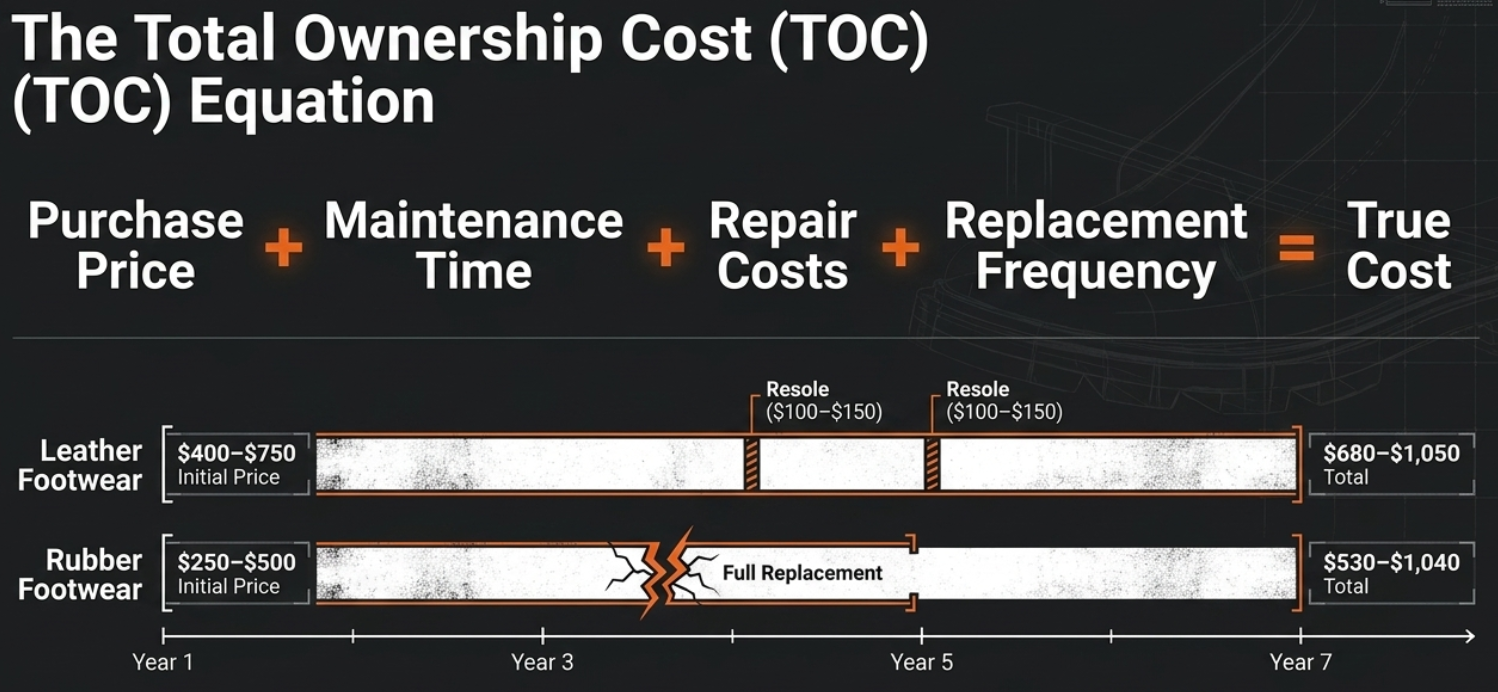
Properly maintained leather boots are often expected to remain in service for five to seven years. Rubber boots are often expected to remain in service for three to four years. Actual service life depends on call volume, wear, contamination, cleaning, drying, storage, and retirement criteria.
Some leather boots use Goodyear welt or other repairable construction. Resoling may cost between $100 and $150, depending on the model and repair scope.
A seven-year ownership estimate places leather boots between $680 and $1,050 after maintenance and resoling. Rubber boots may total between $530 and $1,040 when two sets are required during the same period.
Those ranges overlap. Expensive leather boots are not automatically cheaper over time.
A useful total-cost review should include:
- Purchase price
- Expected issue period
- Cleaning and care costs
- Resole or rebuild costs
- Backup inventory
- Replacement frequency
- Downtime during repair
- Premature retirement from damage or contamination
Assuming Leather Is Better for Every Call
Leather boots are associated with breathability, flexibility, extended wear, and more advanced fit systems. Those characteristics often matter during structural operations, technical rescue, ladder work, confined spaces, and warm-weather shifts.
Leather also brings tradeoffs.
The upper may absorb water after its water-repellent treatment degrades. Saturated leather becomes heavier and requires extended drying. Damaged seams or barriers may allow water entry. Some chemicals, acids, petroleum products, and industrial contaminants may damage leather.
A leather boot may be the right everyday structural boot without being the preferred option for prolonged water exposure or aggressive chemical contamination.
Assuming Rubber Is Only a Low-Cost Compromise
Rubber boots use molded construction and provide immediate water resistance without a leather break-in period. They support direct issue when replacement speed matters.
Rubber boots also fit several demanding assignments:
- Standing water
- Flooded basements
- Water rescue
- Vehicle-fluid exposure
- Contamination events
- Cold-weather response
- Backup inventory
- Rapid replacement
The tradeoffs include reduced breathability, less fit adaptation, limited ankle flexibility, shorter expected service life, and limited repairability.
Rubber is not automatically inferior. It solves a different set of operating problems.
Ignoring Individual Fit
Department-wide standardization simplifies purchasing, but firefighter feet are not standardized.
Fit issues may include:
- Wide feet
- Narrow heels
- High arches
- Flat feet
- Bunions
- Heel slippage
- Pressure points
- Short or long toes
- Uneven foot volume
Premium leather boots often include adjustable widths, removable filler layers, custom lacing, heel-locking systems, and multi-density footbeds. Rubber boots may provide shaped lasts and removable footbeds but generally do not mold to the foot over time.
A model with strong specifications still fails the user when the fit is wrong.
Failing to Verify Serviceability
“Rebuildable” and “resoleable” should never be assumed from appearance or price.
Some leather boots use repairable construction. Others have model-specific limits. Most rubber boots require full replacement when the molded outsole reaches its retirement point.
Before treating a higher purchase price as a lifecycle investment, verify:
- Whether the specific model is resoleable
- Which components may be replaced
- Who is authorized to perform the work
- Repair pricing
- Turnaround time
- Inspection requirements
- Conditions that make the boot ineligible for repair

Current Operational Gaps
Many departments still specify footwear around three fields: certification, size, and unit price. That approach misses the conditions that often determine whether the boot works for the wearer.
A complete specification should account for call profile. A department with frequent flooded basements, industrial sites, vehicle fires, and contamination events has different needs from a department focused on high-call-volume structural work in a warm climate.
Inventory strategy is another gap. Some departments expect one boot type to cover every assignment. A more practical approach may use leather as the primary structural boot while rubber supports water-heavy incidents, contamination, cold weather, backup issue, or rapid replacement.
Maintenance capacity is also overlooked during procurement. A leather boot that requires conditioning and controlled drying needs a department process. A moisture-barrier boot needs inspection for seam, liner, and upper damage. A rubber boot still needs tread, toe, shank, lining, and shell inspection.
Certification review needs equal discipline. Buyers should verify the exact standard, edition, certification body, and model configuration. A general brand claim is not enough.
Technical Evaluation and Buying Considerations
Verify the Certification
Confirm the exact model and current certification edition. Do not rely on a general statement that the brand or product category is NFPA compliant.
Request documentation for:
- NFPA standard
- Edition year
- Certification body
- Model number
- Approved configuration
- Applicable use
- Care and retirement instructions
Fit the Firefighter, Not the Size Chart
A numerical size is only the starting point. Check heel retention, toe room, width, arch contact, ankle movement, and pressure points.
Fit testing should include:
- Walking
- Stairs
- Ladder movement
- Kneeling
- Squatting
- Simulated tool work
- Turnout pant interface
- Typical department socks
The X2 multi-fit system may help departments address multiple widths. The Rubber Firefighter Boot’s Comfort Fit last and shaped toe area may also support a roomier fit. Each wearer still needs an individual assessment.
Match the Boot to the Incident Profile
Leather may fit departments that prioritize:
- Extended structural work
- Warm-weather operations
- Mobility
- Adjustable fit
- Long-shift comfort
- Repairable construction, when confirmed
Rubber may fit departments that prioritize:
- Standing water
- Flooded environments
- Vehicle fluids
- Chemical exposure
- Cold weather
- Immediate issue
- Backup inventory
- Simplified exterior cleaning
Departments with mixed incident profiles should determine whether both boot types are justified.
Review the Moisture and Contamination Strategy
A leather boot with a CROSSTECH membrane uses a barrier system within the boot. The outer leather, seams, membrane, and lining all require inspection and care.
A rubber boot uses a molded exterior shell for water resistance. Buyers should still verify chemical compatibility, decontamination procedures, shell inspection, and liner condition.
Do not assume any boot is appropriate for every hazardous material. Use the manufacturer’s documented exposure limits and department hazmat procedures.
Confirm Maintenance Requirements
For leather, verify:
- Approved cleaning products
- Conditioning schedule
- Drying method
- Maximum drying temperature
- Inspection points
- Moisture-barrier care
- Retirement criteria
For rubber, verify:
- Approved detergents
- Decontamination limits
- Shell inspection
- Lining inspection
- Tread limits
- Storage conditions
- Retirement criteria
Calculate Long-Term Value With Real Assumptions
Do not use generic lifecycle figures without adjusting them to your department.
Use this framework:
Total ownership cost = Purchase cost + Maintenance + Repair + Replacement + Downtime
Document every assumption. A leather boot only earns repair value when the model is eligible for repair and the upper remains serviceable. A rubber boot’s lower purchase price only remains lower when replacement frequency stays within budget expectations.
The Hunter Apparatus Solution
Hunter Apparatus supplies Fire/Rescue/EMS organizations with apparatus, equipment, and Personal Protective Equipment. Our role is not to tell every firefighter to buy the most expensive option. We help departments compare documented features against the work their personnel perform.
Black Diamond offers both rubber and leather firefighter boot options. That gives departments a practical way to evaluate different construction approaches within one product category.
Our Standard
At Hunter Apparatus, firefighter footwear is evaluated through practical verification. The focus is on real-world fit, turnout compatibility, duty schedule, movement demands, certification, construction, barrier systems, and intended use. Every recommendation should be tied to documented product details and the conditions firefighters will actually face.
Serviceability and long-term value also matter. Buyers should know whether a boot can be repaired, resoled, cleaned, decontaminated, and returned to service before making a purchase. Purchase price is only one part of the decision. Care requirements, repair options, replacement frequency, downtime, climate, call profile, and department procurement needs all belong in the evaluation.
Conclusion: Are Expensive Firefighter Boots Worth It?
Are expensive firefighter boots worth it? They are worth the cost when the added features match the firefighter, the operating environment, and the department’s maintenance plan.
A higher-priced leather boot may provide adjustable fit, heel retention, a moisture barrier, and repair-oriented construction. A rubber boot may provide immediate deployment, molded water resistance, steel protection components, and simpler exterior care.
Neither choice should be made by price or material alone.
Contact Hunter Apparatus to review our boot options, confirm current specifications, and match footwear to your department’s actual requirements.
FAQs About Are Expensive Firefighter Boots Worth It
In This Article
- Key Takeaways
- Understanding Whether Expensive Firefighter Boots Are Worth It
- Why Firefighter Boot Value Matters for Firefighters
- Common Challenges, Risks, and Buyer Mistakes
- Current Operational Gaps
- Technical Evaluation and Buying Considerations
- The Hunter Apparatus Solution
- Conclusion: Are Expensive Firefighter Boots Worth It?
- FAQs About Are Expensive Firefighter Boots Worth It
- Reliability You Can Count On. Peace of Mind You Can Trust