
How to Pick the Best Medical Boots
National Fire Protection Association (NFPA) data for 2024 indicates that strains, sprains, and muscular pain accounted for 58 percent of all injuries sustained during non-fire emergency responses. Selecting high-performance Medical Boots is the most direct way to mitigate these physical risks while ensuring compliance with stringent safety protocols. This analysis examines technical standards, operational challenges in the Southeast, and the specific equipment solutions offered by Hunter Apparatus to maintain mission readiness.
Understanding Medical Boots: Standards and Specifications
Medical Boots are not standard duty footwear; they are engineered environmental barriers designed to meet the rigorous demands of emergency medical services (EMS). In the B2B procurement space, the term refers specifically to footwear that adheres to the NFPA 1999 Standard on Protective Clothing and Ensembles for Emergency Medical Operations. This standard dictates that footwear must provide a verifiable barrier against liquid-borne pathogens while maintaining physical durability during high-intensity operations.
The technical authority of a boot is defined by its ability to resist bloodborne pathogen penetration. Footwear must pass specific laboratory tests where materials are exposed to surrogate viruses under pressure to ensure that no microscopic contaminants reach the skin of the provider. For agencies operating in high-volume municipal environments, this is a non-negotiable safety requirement. The ASTM F1671 test protocol, for instance, challenges the material with Phi-X174 bacteriophage. A pass indicates that the membrane remained intact under high pressure.
Physical construction also defines the category. True medical-grade boots incorporate puncture-resistant soles and reinforced toe caps to protect against the physical hazards of a scene. Whether navigating a multi-vehicle collision or an industrial site, the boot serves as a primary piece of personal protective equipment (PPE). It must resist abrasion from jagged metal and glass while supporting the wearer’s weight on uneven surfaces.
The Mechanics of Puncture Resistance
Puncture resistance in high-end Medical Boots is typically achieved through a stainless steel or high-strength composite plate integrated into the sole. This plate must be flexible enough to allow for a natural gait while remaining stiff enough to stop a nail or shard from penetrating the footbed. In a pre-hospital environment, the ground is rarely clear. Providers often step into tall grass or debris where sharp hazards are hidden from view.
Impact and Compression Ratings
Safety toes are another critical component. These are tested for impact (heavy objects falling) and compression (heavy objects rolling over the foot). A reinforced toe cap must maintain a minimum clearance inside the boot even after a significant force is applied. This prevents the “crush” injuries that can lead to permanent disability or toe amputation.
The Stakes of Professional Footwear in Emergency Care
The decision to invest in premium Medical Boots carries significant implications for agency leadership. It is not merely a matter of individual comfort but a strategic choice that impacts the entire operational lifecycle of an EMS organization. Leadership must view footwear as a capital investment in their most valuable asset: their people.
Mission Readiness and Operational Continuity
Mission readiness depends on the health of the personnel. When a paramedic or EMT is sidelined by a foot or ankle injury, the resulting staffing gap puts additional strain on the remaining crew. In 2024, NFPA estimates showed that 17 percent of firefighter and EMS injuries resulted in lost time. Premium footwear reduces this percentage by providing the stability required to prevent the slips and trips that lead to long-term disability.
A single workers’ compensation claim for a chronic back injury often exceeds the cost of equipping an entire department with elite footwear. By stabilizing the foundation of the body, these boots reduce the upward kinetic chain of stress that affects the lower back. This proactive approach to injury prevention ensures that more units remain in service during peak call volumes.
Personnel Safety and Long Term Physical Health
The physical toll of the EMS profession is cumulative. Long shifts spent on concrete, asphalt, and uneven terrain lead to musculoskeletal disorders that can shorten a career. High-quality Medical Boots provide the orthopedic support necessary to maintain proper alignment of the feet, knees, and hips. Without this support, providers often experience chronic pain that reduces their operational effectiveness over time.
Plantar fasciitis and fallen arches are common among veteran first responders. These conditions are not just painful: they are expensive to treat and can lead to permanent gait changes. Quality boots incorporate arch support systems and energy-return foams that keep the foot in a neutral position, even during the twelfth hour of a shift.
Regulatory Compliance and Liability Mitigation
From a procurement and administrative perspective, liability is a constant concern. Providing footwear that meets NFPA 1999 and OSHA bloodborne pathogen standards creates a legal shield for the organization. In the event of an exposure incident or a workplace injury, having documented proof that the agency issued certified, high-standard PPE is a critical component of risk management.
Agencies that issue sub-standard footwear may find themselves liable for negligence if a provider suffers an infection from a needle stick or blood exposure. The cost of a single post-exposure prophylaxis (PEP) regimen and the associated testing is significant. Certified boots act as a preventative measure that satisfies both safety audits and insurance requirements.
The Core Challenges of Modern EMS Footwear
Agencies face a complex landscape of obstacles when selecting equipment for their teams. These challenges range from biological threats to the specific climate of the operating region. The modern EMS environment is more hazardous and high-tempo than at any point in history.
Pathogen Persistence and Biohazard Exposure
Pathogens such as HIV, Hepatitis B, and various antibiotic-resistant bacteria are a daily reality in pre-hospital care. Standard leather or nylon boots often have porous surfaces that can trap these contaminants, making them difficult to disinfect. Medical Boots must utilize non-porous materials or advanced membranes that prevent the absorption of fluids. If a boot absorbs blood or vomit, it becomes a biohazard that the provider brings back into the ambulance and the station.
The persistence of these pathogens on gear is a major concern for cross-contamination. A boot that can be easily wiped down or that has an antimicrobial treatment helps break the chain of infection. This protection extends beyond the individual provider to their families, as it prevents the “hitchhiking” of pathogens from the scene to the home.
Foot Fatigue and the Ergonomic Crisis
The 12-hour or 24-hour shift structure of EMS creates an ergonomic crisis for the feet. Constant standing and lifting of heavy patients (often over 200 pounds) creates immense pressure on the arches and heels. If the boot lacks a sophisticated energy return system, the provider will experience rapid fatigue. This fatigue does not just cause pain; it leads to slower response times and potential errors in patient care due to physical exhaustion.
Muscle fatigue leads to poor lifting technique. When a provider’s legs are tired, they are more likely to use their back to lift a stretcher, leading to acute injury. High-performance boots use lightweight materials and specialized midsoles to reduce the “dead weight” a provider must lift with every step, which can total thousands of pounds of saved effort over a single shift.
The Environmental Extremes of the Southeast
For agencies in Florida, Georgia, and Alabama, the environment is a primary adversary. High humidity and extreme heat accelerate the breakdown of adhesives and materials in lower-quality boots. Furthermore, a boot that does not breathe will lead to “swamp foot” and fungal infections, which are significant issues in the humid Southeast climate. Footwear must balance total waterproofing with high levels of vapor permeability to ensure the foot stays dry from both external rain and internal sweat.
The intense ultraviolet (UV) exposure in the Southeast can also cause standard rubber and leather to crack and degrade prematurely. Equipment in this region must be built with materials that are UV-stabilized and heat-resistant. A boot that fails mid-shift due to delamination is an operational hazard that cannot be ignored by procurement officers.
Hunter Apparatus: Engineering Stability for First Responders
Hunter Apparatus, founded in 2019 and based in Florida, is a mission-critical procurement partner serving the Southeast. The company specializes in providing vetted apparatus and equipment that meet the highest standards of reliability. By focusing on proven manufacturing partners, Hunter Apparatus ensures that every piece of gear, including Medical Boots, is ready for the field.
Our commitment to “Reliability You Can Count On” is reflected in our partnership with Black Diamond, a leader in high-performance footwear. Hunter Apparatus provides these solutions to fire departments, private transport providers, and hospital systems across the region. We understand that gear is not a commodity: it is a lifeline.
The Black Diamond Advantage: X2 Leather Fire Boots
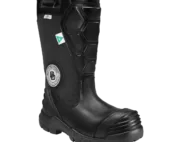
The Black Diamond X2 Leather Fire Boot is the flagship solution for providers who require a hybrid of fire and medical protection. This boot is explicitly certified to NFPA 1999 for Emergency Medical Operations, making it one of the most versatile pieces of PPE in the Hunter Apparatus catalog. It is designed to withstand the heat of a structural fire while offering the agility required for medical calls.
CROSSTECH Waterproof Membranes
The X2 utilizes a CROSSTECH membrane, which is the industry gold standard for liquid and pathogen protection. Unlike generic waterproof layers, CROSSTECH is specifically engineered to block blood and body fluids while allowing perspiration vapor to escape. This ensures that the provider’s feet remain dry and protected from viral threats even in the most saturated environments. It is a membrane that performs under the heat and pressure of actual emergency scenes.
ORTHOLITE Three Density Footbeds
Comfort in the X2 is driven by the ORTHOLITE footbed system. This system uses three different densities of foam to provide targeted cushioning. The top layer provides immediate comfort, while the lower layers offer high-rebound energy return and long-term support. This is critical for preventing the 58 percent of musculoskeletal injuries mentioned in recent NFPA data. The foam is also open-cell, which improves airflow around the foot and reduces heat buildup.
The Custom Multi Fit System
One of the primary challenges in B2B footwear procurement is the variety of foot shapes within a crew. The Black Diamond X2 solves this with a Custom Multi-Fit system. Each boot comes with a set of removable filler layers that allow a single pair of boots to be adjusted for medium, wide, or extra-wide fits. This reduces the logistical burden on procurement officers, as they can stock fewer SKUs while still ensuring a perfect fit for every member of the department. This system eliminates the “pinch points” that often lead to provider dissatisfaction.
Black Diamond Rubber Boots for Specialized Hazards
For high-hazard environments where decontamination is the primary priority, Hunter Apparatus offers the Black Diamond Rubber Firefighter Boot. These 16-inch boots are NFPA 1971 and 1992 compliant, providing a completely impermeable barrier. They are the ideal choice for hazardous materials (HazMat) response or industrial medical roles.
These boots feature a steel safety toe and a stainless steel puncture-resistant plate, ensuring that the foot is protected from crushing forces and sharp objects. They are also Electrical Hazard (EH) tested to 18 kV, providing essential safety for crews working around downed power lines or industrial accidents. The smooth rubber surface allows for rapid and thorough decontamination, which is vital after exposure to hazardous chemicals or biological agents. The high-traction sole ensures that even on oily or wet surfaces, the provider remains upright.
The Decision Criteria for Procurement Officers
When evaluating which Medical Boots to issue to a department, several critical factors must be validated. Failing to account for these can lead to equipment failure and increased injury rates. Procurement is a balance of performance, safety, and total cost of ownership.
The Importance of the 3-Point Heel Lock
A common failure in EMS boots is heel slippage, which causes blisters and instability. Black Diamond boots utilize a 3-Point Heel Locking system. This internal engineering feature grips the ankle and heel firmly, preventing the foot from sliding forward during downhill movements or shifting side-to-side during lateral maneuvers. This locking mechanism is essential for maintaining balance when carrying a stretcher over uneven terrain or moving a patient down a flight of stairs.
Stitch Down Lining Longevity
In lower-quality footwear, the internal lining often pulls out when the provider removes the boot, especially if the boot is damp. This “liner pull-out” makes the boot nearly impossible to put back on quickly during a mid-night call. Black Diamond addresses this by using stitched-down linings and high-abrasion nylon heel linings. This ensures that the interior of the boot stays intact for years of daily use. It is a small detail that has a major impact on provider frustration and equipment lifespan.
Breathability in High-Heat Zones
For the Southeast region, thermal regulation is a safety issue. A boot that traps heat can lead to heat exhaustion in the field. Procurement officers should look for boots that incorporate moisture-wicking linings and breathable membranes. The X2’s leather is treated to be breathable while remaining flame-resistant and waterproof, providing a balanced micro-climate for the foot. This prevents the skin softening and blistering associated with prolonged exposure to sweat.
Outsole Compound and Tread Design
The outsole must provide a “multi-directional” grip. Emergency responders do not just walk forward: they pivot, crawl, and brace themselves at odd angles. The tread design should be self-cleaning, meaning it ejects mud and debris as the wearer walks. This prevents the boot from becoming a “slick” when moving from a muddy field onto a polished hospital floor.
Strategic Procurement: Budgeting for Longevity
B2B buyers often face pressure to choose the lowest-cost option. However, the total cost of ownership for Medical Boots reveals that “cheap” boots are significantly more expensive over a three-year period. A standard duty boot may last six to nine months before the support structure collapses or the sole delaminates.
In contrast, a premium boot from Hunter Apparatus, such as the Black Diamond X2, is designed to last several years of daily duty. When the cost of replacement and the potential cost of a single slip-and-fall injury are factored in, the premium boot becomes the fiscally responsible choice. Quality gear is a retention tool: providers feel valued when their agency invests in equipment that protects their health.

Conclusion: Medical Boots
Selecting the best Medical Boots is an investment in the longevity and safety of the first responder workforce. By prioritizing NFPA 1999 certification, pathogen-resistant membranes like CROSSTECH, and advanced ergonomic systems like ORTHOLITE, agencies can significantly reduce the risk of workplace injuries and lost time. The foundation of a successful emergency response starts with the feet of the providers.
Hunter Apparatus remains the premier choice for agencies seeking these high-authority solutions. Through our partnership with Black Diamond, we provide footwear that bridges the gap between standard duty wear and mission-critical protection. Reliability and peace of mind are achieved when the gear matches the intensity of the mission. For leadership, the goal is clear: send every provider home as healthy as they were when they started their shift.
For agencies ready to upgrade their PPE standards, contacting Hunter Apparatus for a technical evaluation and quote is the first step toward a safer, more resilient team.
FAQs About Medical Boots
In This Article